Beeja/Seed: The Source of Form and Thought
Updated: Jan 13

A seed rests in the soil without instruction.It carries no image of the tree it will become.What it holds is a direction. Given light, water, and time, the seed does not decide its form. It responds. Roots move downward. The stem moves upward. Leaves appear when the conditions allow them. What we later recognise as beauty is not intention, but consequence.
Nature does not rush toward expression. It first establishes order.
Creation, in this sense, is not an act of making, but an act of allowing.
The same elements—earth, water, fire, air, space—are present everywhere. Yet their outcomes are never identical. A palm tree and a banyan stand on the same ground and grow into entirely different forms. Each follows its own inner necessity. Nature does not seek variation, but it never produces repetition.
In Languague...

This idea of creation as unfolding rather than construction is embedded deeply in the Sanskrit language. Meaning does not begin with explanation. It begins with sound. At the smallest level are bījākṣaras—seed syllables. They are not descriptive words. They are condensed fields of meaning.
The bījākṣara Hrīm (ह्रीं) is one such seed. Traditionally, it is said to give rise to multiple meanings, not by definition but by resonance. From Hrīm emerge qualities such as lājjā (modesty), śrī (auspicious beauty), smṛti (inner remembrance), dhṛti (steadiness), and medhā (clarity of intelligence). These are not separate ideas assembled together. They are different expressions of the same inner tone.
Hrīm is often broken down into its sonic components—ha, ra, ī, and ṁ. Each carries a force: movement, fire, expansion, and containment. When held together, they do not point outward to an object. They turn attention inward. Like a seed placed in the right soil, Hrīm does not instruct the mind; it prepares the ground in which meaning can arise.
In Music...

Music follows a similar logic. A rāga is not a melody but a generative condition.
Hamsadhvani, for example, is built from a precise selection of swaras—Sa, Ri₂, Ga₃, Pa, Ni₃, Sa. Certain notes are absent. Certain movements are emphasised. Its characteristic phrases lift upward quickly, avoiding heaviness. From these constraints, a distinct presence emerges.
For example Hamsadhvani (Raga)is traditionally associated with maṅgala—auspicious beginnings. It evokes clarity, freshness, invocation, and lightness. This is why it is often played at the start of concerts. The rāga does not state joy; it creates the conditions in which joy naturally appears. Different musicians may render it differently, stretching or compressing time, but the rāga remains recognisable. The seed holds.
In Architecture....
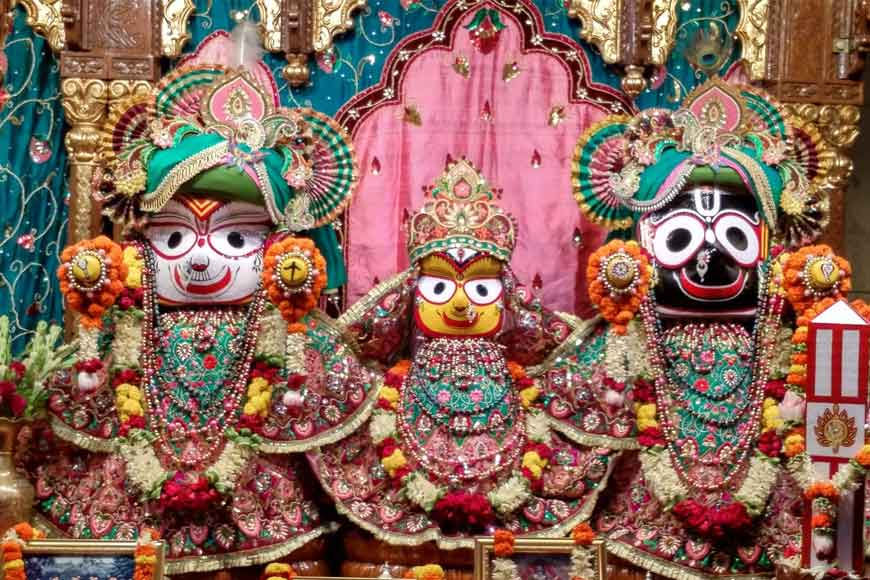

Architecture, too, follows this inner logic when it is rooted in tradition. The Jagannātha temple in Puri begins not with architectural flourish, but with a radically simple seed—the deity itself. Jagannātha is not anthropomorphically complete. He is circular-eyed, stump-limbed, unfinished. A form that resists refinement.
This seed-form shapes everything around it. The temple does not attempt to beautify or complete the deity. Instead, it builds protection, procession, and enclosure around this powerful centre. The towering śikhara rises like an offering, while the garbhagṛha remains dark, compressed, and inward. The architecture is not expressive in itself; it exists to hold intensity.
Movement through the temple mirrors the deity’s nature. Pilgrimage, circumambulation, the annual Rath Yātrā—these are not decorative rituals.
They are spatial expressions of the same seed idea: the god as cosmic presence, accessible yet overwhelming, simple yet immense. The architecture unfolds outward from this core, just as a tree expands from its seed.
This is Vāstu in its original sense—not prescription, but alignment. An effort to allow form to arise from essence, rather than impose form upon it.
Conclusion
Nature includes decay as part of creation. Leaves fall. Sound dissolves. Stone erodes. Even Jagannātha’s wooden form is periodically renewed. Nothing is designed to remain untouched. What continues is not the object, but the principle.
Modern design often attempts to resolve everything too early. It seeks finality where nature prefers process. But seeds do not aim for completion. They aim for continuity. Design, then, becomes less about expression and more about responsibility. The responsibility to listen, to reduce interference, and to create the right conditions for something essential to emerge.
When this happens, the result does not call attention to itself.It feels natural.As though it had always been waiting to exist.
This way of understanding creation is not metaphorical but foundational in the Indic tradition.
Vedic Reference
The Vedic view does not describe the universe as something made, but as something that emerges. The Ṛg Veda speaks of an underlying order—ṛta—through which forms arise when conditions align, not through force, command, or manufacture. Ṛta is not imposed upon the world; it is the rhythm by which the world holds together.
ऋतं च सत्यं चाभीद्धात् तपसोऽध्यजायत ।(Ṛg Veda 10.190.1)
Ṛta and satya are said to be born of tapas—an inward intensity, not an external act. Order precedes structure. Truth precedes form. Creation is described not as intervention, but as consequence.
The Upaniṣads return repeatedly to this idea, refusing the image of a craftsman-like creator. Instead, they speak of a source from which beings unfold naturally—sustained without effort, resolved without violence.
यतो वा इमानि भूतानि जायन्ते ।येन जातानि जीवन्ति ।यत्प्रयन्त्यभिसंविशन्ति ।(Taittirīya Upaniṣad 3.1)
That from which these forms are born,by which they live,and into which they dissolve.
There is no drama of construction here. No insistence on completion. What exists arises, abides, and withdraws—like breath, like sound, like growth.
In this worldview, sound precedes structure. Vāc is not merely speech, but the principle through which form becomes perceptible. Meaning does not exist independently of resonance; it appears only when sound is received, held, and allowed to settle.
वाचारम्भणं विकारो नामधेयं ।(Chāndogya Upaniṣad 6.1.4)
Form is a modulation of speech;difference is only a name.
Whether in mantra, music, or architecture, creation is treated as an act of alignment with an underlying order. The human role is not to impose design, but to recognize the seed and prepare the space in which it can reveal itself.
This is why the bījākṣara does not describe, the rāga does not declare, and the temple does not explain. Each establishes a condition. Each listens before it acts.
When alignment is correct, form appears inevitable.When it is not, no amount of intention can save it. This is not minimalism as reduction, but as restraint.Not silence as absence, but as readiness.
Design, then, returns to its original responsibility: to honor continuity over control, process over performance and emergence over expression.
When this happens, the result does not announce itself. It feels inevitable. As though it had always been waiting to exist.

Comments