The Making of the Book: Srimad Ramayana

There are stories that are told, and there are stories that are inhabited. The Ramayana belongs to the latter. It lives in memory, in performance, in ritual, in fragments of song and image that travel across generations. To design a book around it is not simply to arrange text and illustrations—it is to ask: how does a story like this take form today?
The project began with urgency. A book for young readers—ages 10 to 16. A timeline of three months. A scale that extended beyond a single publication, into classrooms and schools across regions.
But beneath the constraints lay a quieter challenge: how to create something that is at once structured and alive, capable of carrying a vast narrative without reducing its depth.
Listening before drawing
The first instinct was familiar—seek contemporary expression. Commission artists, reinterpret scenes, build a visual language from scratch. But early explorations felt unanchored. The imagery was compelling, but the system was not. There was no rhythm that could sustain the scale of the story.
It was here that the process slowed down.
Instead of asking how to illustrate, the question shifted to:what visual systems already exist that know how to tell stories like this?
This shift—from making to observing—became the foundation of the project.
The intelligence of tradition
Across India, narrative traditions have long been embedded in visual form. Painted scrolls, temple murals, cloth-based storytelling traditions—each carries within it a grammar of sequencing, hierarchy, and rhythm.
Among these, Pattachitra revealed something striking.
At first glance, it appears ornate—dense with pattern, colour, and detail. But look closer, and a structure emerges. Scenes are framed within borders. Figures are scaled to denote importance. Narratives unfold in panels, each connected yet distinct. There is no emptiness; every space carries intent.
It is not just decorative—it is systematic.
And in that system lies its strength.

From painted scroll to printed page
What followed was not an act of translation, but of alignment.
The team began to treat the painting not as an illustration, but as a framework. What if the book could be built the way these paintings are built?
Gradually, a structure took shape:
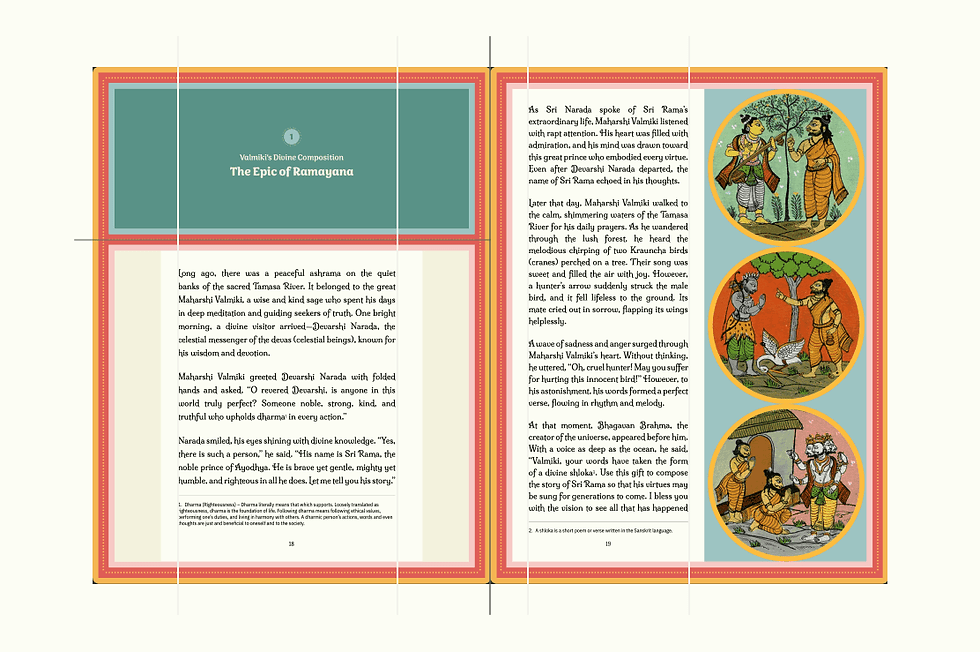
The borders of the painting became the edges of the page
The division of scenes informed the flow of narrative
The hierarchy of figures guided the placement of text and image
The density of composition influenced the rhythm of layout
The book was not designed in isolation—it was grown from an existing logic.
In this process, design moved away from style and toward something more fundamental:relationships—between elements, between sequences, between reading and seeing.
A dispersed act of making
The making of the book unfolded across distances.
In Sringeri, scholars and writers shaped the narrative.In Bangalore, the design system evolved—testing grids, margins, and page flows.In Odisha, artist Karunakara Sahu and his team worked patiently, creating over 85 paintings, each aligned to defined proportions and narrative requirements.
What connected these geographies was not proximity, but clarity.
Because the system defined the rules, the work could move in parallel. Decisions became less about correction and more about execution. The process, though distributed, remained coherent.
The weight of material decisions
Beyond narrative and image lay another layer—material.
The book was intended to reach classrooms, to be printed in large numbers, to be handled, read, and revisited. This meant that every decision—paper size, printing format, layout efficiency—carried weight.
A single sheet of paper, measured at 20” x 30”, would yield eight pages. Margins had to account for trimming. Borders had to survive printing constraints. Costs had to remain viable without compromising clarity.
Here, design met reality—not as limitation, but as context.

When the book begins to travel
Once printed, the book began its own journey.
Into classrooms.Into the hands of students encountering the story, perhaps for the first time.Into systems where it was not only read, but studied—eventually even forming the basis of examinations.
What made it effective was not just the content, but the way it unfolded—visually structured, sequential, accessible. The reader did not have to navigate the story alone; the book guided them.

Beyond the page
The logic of the book did not end with the book.
When extended into an exhibition, the same principles reappeared—this time in space. Panels arranged themselves around a central axis, radiating outward. The narrative wrapped around the viewer, no longer bound by pages.
Original paintings, printed panels, artist demonstrations, children engaging with form and story—the experience expanded, but the underlying system remained intact.
The story adapted. The structure held.


What the process revealed
In the end, the project offered a quiet but significant insight:
That design does not always begin with invention.Sometimes, it begins with recognition.
Recognition of patterns that already exist.Of systems that have endured because they work. Of ways of seeing that are embedded in tradition, waiting to be understood.
The Ramayana did not need to be reimagined.It needed to be re-seen—through a lens that respects both its scale and its subtlety.
And in that act of seeing, a new form emerged—one that allows the story to move forward, carried not just by words, but by structure, image, and experience.


Comments