Freedom Fighters Memorial, Chikmagalur: Designing memory in stone and silence
Updated: Jan 19
The Freedom Fighters Memorial in Chikmagalur, inaugurated on Gandhi Jayanti by the Brigade Foundation, stands at Hosamane Circle as a place of remembrance, reflection, and resolve. More than a commemorative structure, the memorial is conceived as a civic space—one that invites citizens, especially young minds, to encounter the values, sacrifices, and courage that shaped India’s freedom struggle.

From the first step, the experience as designed by the architect is intentionally spatial. Visitors ascend a series of stone steps that lead them toward a mural of Mahatma Gandhi, depicted in his iconic spinning-wheel pose. This act of walking upward is symbolic: a gradual transition from the everyday city into a landscape of memory. The use of rough stone throughout the memorial echoes the hardship and endurance that defined the freedom movement, grounding the experience in material honesty rather than ornamental excess.
Environmental graphics as architecture, not add-ons
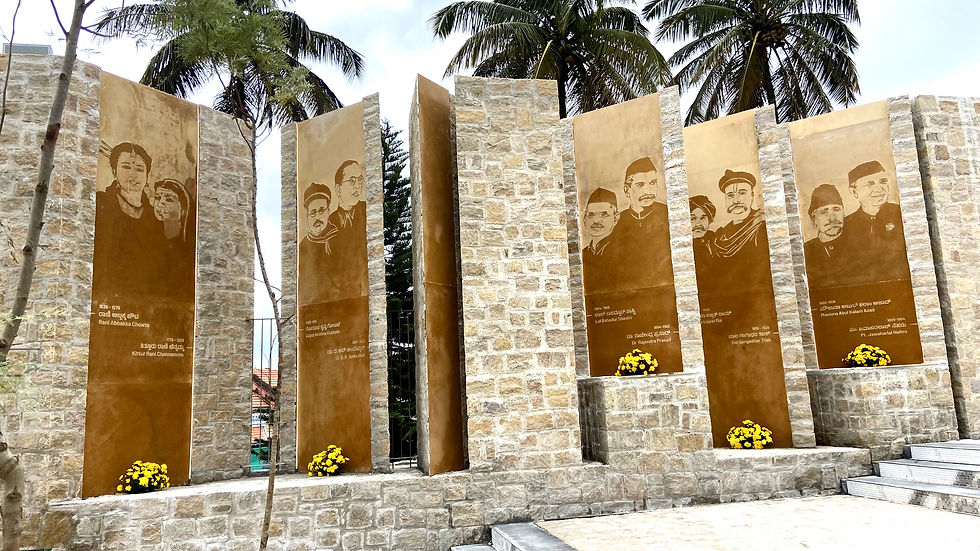
Our approach to the environmental graphic design was rooted in integration. The signage and graphics are not applied layers; they are embedded into the architecture itself. Carved into stone and paired with Jaisalmer golden-yellow stone panels, the narratives of India’s freedom fighters emerge as part of the built form. This ensures durability, dignity, and a sense of permanence—qualities essential for a memorial meant to endure across generations.
Rather than relying on conventional plaques or panels, the design treats information as architectural presence. Names and stories are revealed through proportion, placement, and rhythm, allowing visitors to encounter history as they move through space.
Monumental, yet quiet
A key design intent was restraint. The graphics are simple and silent, avoiding visual noise or dramatic illustration. This silence is deliberate—it creates room for contemplation and respect. Yet within this quietness lies depth: the scale, materiality, and spatial sequencing communicate the heroism and sacrifice of the freedom fighters without overt dramatization.
The memorial narrates the stories of 20 figures such as Rani Abbakka Chowta, Kittur Rani Chennamma, Dr. B R Ambedkar, Subhash Chandra Bose, Bhagat Singh, Rani Lakshmi Bai, and many others—not as distant icons, but as presences woven into the everyday life of the city.
Standing among us, not framed before us
One of the most important ideas guiding the graphic and spatial language was to avoid portraiture in the conventional sense. The freedom fighters are not framed, isolated, or elevated onto pedestals as distant figures from the past. Instead, they are positioned at varying heights and angles, distributed across the plaza so that they feel as though they are standing among us.
As people walk through the open plaza, these vertical follies create a subtle sense of protection and guardianship—as if history is watching over the present. The experience is immersive rather than observational; visitors are not merely looking at history, they are walking with it.
Past and future, facing each other
The location of the memorial adds a powerful layer of meaning. On one side lies the narrative of the past, embodied in stone, struggle, and sacrifice. On the other stands a neighbouring school, representing the future. This juxtaposition is not accidental—it reinforces the memorial’s role as a bridge between generations, reminding young citizens that their freedoms are rooted in real lives, real courage, and real loss.
Designing for collective memory
The Freedom Fighters Memorial in Chikmagalur demonstrates how environmental graphic design can go beyond information and aesthetics to shape collective memory. By integrating graphics into architecture, embracing material honesty, and choosing silence over spectacle, the design allows history to speak with dignity.
Here, remembrance is not imposed—it is experienced. And as citizens pass through the plaza, the memorial quietly fulfills its purpose: keeping the freedom struggle present, personal, and profoundly human.
Team
Client: Brigade Foundation
Architects: Sanjay Mohe, Mindspace
Illustration: Srikantha Umakanta
Construction : Inverika
Environmental Graphics : Tacit
Pictures during Inauguration


Comments