Prof. Kirti Trivedi: Fifty Years in Design, Thought, and Influence
Updated: Jan 19
On December 12, 2025, Prof. Kirti Trivedi marked an extraordinary milestone—50 years of design practice and pedagogy—by opening a deeply moving exhibition that brought together a lifetime of work across product design, exhibition design, publication design, and design education. More than a retrospective, the exhibition felt like a living archive: a rare opportunity to witness how design thinking in India has been shaped, questioned, refined, and carried forward over five decades.
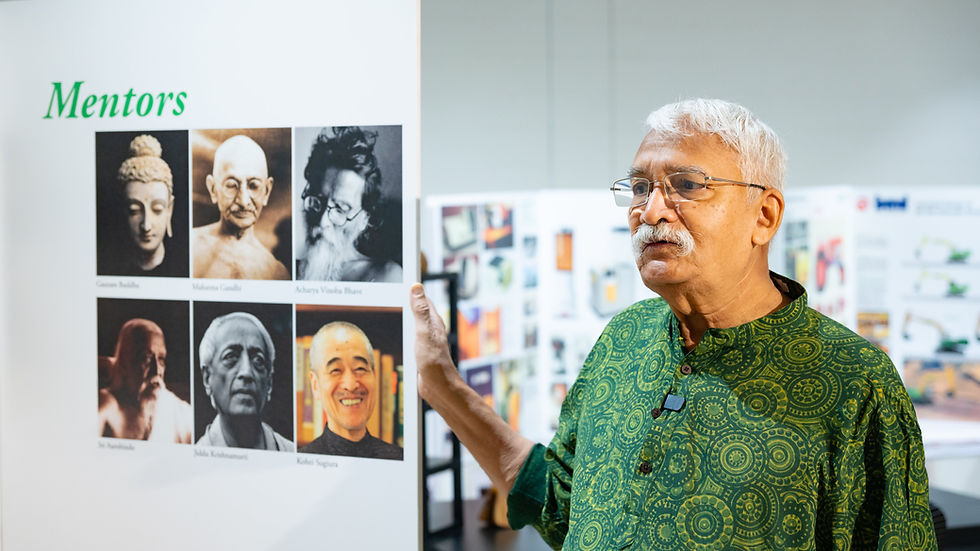
A Journey Through Design
Born in 1948, Prof. Trivedi’s journey into design began with a degree in Mechanical Engineering from the University of Indore. He then pursued a Postgraduate Diploma in Industrial Design from IIT Bombay, followed by a Master of Design from the Royal College of Art, London. This blend of engineering rigor and humanistic design inquiry has remained a defining thread throughout his work.
His formative experiences in Japan in 1981—working with leading design offices and studying under Kohei Sugiura as a UNESCO Fellow—deepened his sensitivity to culture, systems, and visual language. This experience shaped a design worldview that is both global and profoundly rooted in Indian traditions.
Teaching and Mentorship
Since 1976, Prof. Trivedi has been a cornerstone of the Industrial Design Centre (IDC), IIT Bombay. He has taught generations of students in Graphic Design, Typography, Design Methods, and Design History. In 1984, he initiated India’s first Master’s programme in Visual Communication, a landmark moment in the country’s design education landscape.
Alongside teaching, his long-term project documenting the design traditions of India—begun in 1981—stands as an invaluable scholarly contribution. This project bridges classical knowledge systems and contemporary design practice, enriching the field.
A Diverse Portfolio
His professional work spans an extraordinary range. From permanent museum exhibitions such as “My Life is My Message” at Sabarmati Ashram, to exhibitions on Vinoba Bhave and Jamnalal Bajaj, Prof. Trivedi has consistently demonstrated how design can operate at the intersection of culture, public life, and everyday use.
He is perhaps best known as a master book designer, with acclaimed work for publishers like Marg, Mapin, and Osian’s—books that have been celebrated internationally and exhibited at the International Biennale of Book Design in Brno.
The Exhibition Experience
The exhibition celebrating his fifty years was, in itself, a textbook in spatial storytelling. It wasn’t merely a display of finished artifacts; it was an environment that revealed process, thinking, and values. Visitors encountered typography as structure, layout as narrative, and design as a cultural act—lessons that many of us have learned directly from him in classrooms, studios, and conversations.
For designers, the exhibition functioned as a rare form of immersive pedagogy: a space where history, practice, and philosophy coexisted seamlessly.
Personal Significance
For Tacit, this exhibition held a deeply personal significance. Prof. Kirti Trivedi is our design mentor and guru. We have been extraordinarily fortunate to learn under him—absorbing not just skills, but a way of seeing design as a serious, ethical, and culturally grounded discipline. His insistence on respecting content, understanding history, and designing with intellectual honesty continues to shape how we practice today.
His body of work stands as a historical achievement in the fifty-year evolution of design in India. The influence he has had on hundreds—if not thousands—of designers, educators, and leaders is impossible to quantify.
A Learning Experience
Tacit was honored to volunteer in assisting the setup of the exhibition and to help create a rich, reflective atmosphere for designers and visitors in Bangalore. Being part of this process was itself a learning experience—an extension of Prof. Trivedi’s pedagogy, enacted through space, objects, and dialogue.
The exhibition reminded us that graphic design is not merely about aesthetics or trends, but about meaning, memory, and continuity.
As Prof. Trivedi’s papers, lectures, books, and students continue to travel across institutions and generations, one thing is clear: his legacy is not confined to objects or exhibitions. It lives on in the questions he taught us to ask, the care he brought to every detail, and the deep respect he instilled for design as a cultural and intellectual pursuit.
Celebrating fifty years of his work is, in many ways, celebrating the very soul of graphic design in India.
Conclusion
In conclusion, Prof. Kirti Trivedi's journey through design is a testament to the power of creativity and education. His work has not only shaped the landscape of design in India but has also inspired countless individuals to approach design with integrity and cultural awareness. As we reflect on his contributions, we are reminded of the importance of design as a tool for communication, understanding, and connection in our ever-evolving world.
The legacy of Prof. Trivedi will continue to inspire future generations, encouraging them to explore the depths of design and its impact on society. His commitment to fostering a rich design culture in India will resonate for years to come, guiding us all in our creative endeavors.


Comments