Designing Indian stories for children
Tacit has developed a family of books, games, puzzles and exhibition experiences for Sri Sharada Peetham, Sringeri, introducing children to epic narratives, traditional art and spiritual heritage. The projects connect editorial design with participation, allowing children to encounter the same stories through reading, sequencing, assembling images and exploring a shared space.

The work includes the Srimad Ramayana and Shri Mahabharata books for Baala Bharati, the Peetham’s educational initiative; board books on Sri Sharadamba and Sri Adi Shankaracharya; the Ramayana timeline game Katha Krama; Sringeri puzzles; and the Srimad Ramayana exhibition at Shankara Giri. Together, they address a recurring design question: how can a substantial cultural inheritance become accessible and engaging at different stages of childhood?
The approach draws on the structure of Indian visual traditions. In the Srimad Ramayana, Odisha Pattachitra provides the basis for both illustration and page organisation. Narrative passages sit within circular forms, while larger squares and rectangles give emphasis to key moments. Borders and colours establish continuity across the publication. The composition of the paintings becomes a framework for organising text and image. [1]
The Shri Mahabharata extends this visual language while introducing a different organising reference. Its layouts draw on the geometry of the traditional Pagade game mat. Each Parva or group of Parvas is distinguished through colours selected for its bhava, or mood. Coloured borders identify the pre-war, war, Bhagavad Gita and post-war sections, making the divisions legible when the book is viewed as a physical object. [2]
These decisions give cultural references a practical role. Pattachitra informs narrative hierarchy; Pagade informs spatial arrangement. Both contribute to the way the content is encountered. Through Pramana, the concept of measure and proportion within the six limbs of painting, the relationship between these decisions can be understood as a question of scale: how the individual scene, passage and section relate to the larger work. Applying this concept to editorial navigation is a contemporary interpretation of its visual principles. [7]

Observations shared by Tacit show that children use the books in several ways. They follow the full narrative, while shorter pieces of information about characters and events add interest alongside the story. Many also study the books for examinations, returning to them as references to check facts and the storyline.
These behaviours suggest two complementary reading patterns. Continuous reading establishes the larger account; selective reading helps locate a particular person, event or detail. The smaller information elements provide additional points of entry without requiring the reader to begin again. Their value lies partly in the relationship between discovery and verification: the publication must sustain interest and remain useful when a reader arrives with a specific question.
The Katha Krama game translates narrative sequence into a physical task. A set of 60 Pattachitra-style illustrated cards depicts key episodes from the Ramayana. Players arrange the cards chronologically, reconstructing the story through their placement. [6] Tacit has observed that the activity engages children in remembering the sequence and prompts extensive discussion of characters and time within the narrative.

The mechanism makes a temporal relationship visible. Events that are separated across the pages of a book can be considered together on a table. Each placement requires a judgment about what precedes or follows another episode. The observed discussions indicate that this task provides a shared reference for talking about the story. They also reveal how children connect its parts, giving the studio a basis for understanding engagement beyond completion of the game.
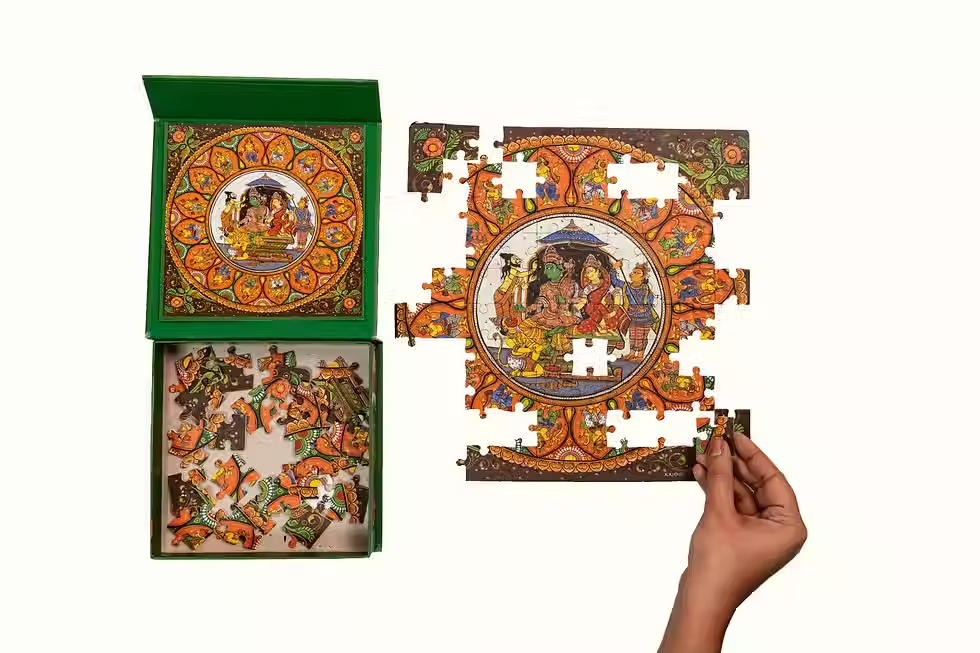
The Sringeri puzzles introduce another form of participation. Available in 36- and 100-piece formats, they present stories associated with Sringeri’s origins and the Ramayana. [4] Assembling an image requires attention to the relationships between fragments. Traditional imagery becomes the material of an activity, with the possibility of introducing its figures and visual conventions through repeated handling.
The board books address an earlier stage of familiarity. Illustrated by Radhika Tipnis, the books on Sri Sharadamba and Sri Adi Shankaracharya begin with simple images and introduce greater detail as they unfold. Borders connect the publications to the wider visual identity of the Peetham. [3] The gradual increase in detail provides a gentler introduction while retaining a connection with the institution’s cultural references.


Auchitya offers a useful theoretical framework for these differences. Developed in Sanskrit poetics as the appropriateness of an expression to its subject and context, the concept can be extended to the relationship between content, format and reader. [8] A first board book, an illustrated reference book and a sequencing game each require a different degree of detail and a different form of participation. Their coherence comes from responding to those conditions within a related cultural vocabulary.
The Ramayana exhibition at Shankara Giri carries the narrative into space. Curated by the Shankara Advaita Research Center and designed by Tacit, it presents 83 Pattachitra paintings in sequence. Modular panels support the display, with short summaries in Kannada and English helping visitors follow the account. Children can engage through colouring and a Vesha photo booth, while demonstrations by artist Karunakara Sahu introduce the process behind the paintings. [5]

The exhibition connects the finished image with its making. The artist’s presence identifies Pattachitra as a living practice, and the activities create opportunities for visitors to participate. Seen through Rasa, the aesthetic experience of the audience, the design question extends to the feelings through which a child might approach the material. Wonder, amusement or concern for a character may invite further attention. [8]
Across the projects, cultural pride is approached through familiarity, participation and respect for the sources. The child is offered several ways to become acquainted with an artistic and narrative tradition. The intention is to make that inheritance available for personal exploration and continued use in everyday life.
The same approach supports an introduction to 'Dharmic living'. The epics provide situations through which children and adults can discuss promises, care, responsibility and the consequences of choices. Dhvani, the theory of suggested meaning associated with Anandavardhana, offers a way to consider what may emerge beyond the explicit account. [9] A child can first learn what happened and later return to consider what an action meant. Design supports that return by making the material accessible, memorable in form and dependable in use.
The strongest evidence so far lies in the uses children have found for the work: reconstructing sequences, discussing characters and narrative time, and consulting books to check details. These observations connect the studio’s intentions with actual engagement. They also suggest a continuing role for design in helping children move between curiosity, close study and a growing understanding of the stories.
Project and concept references
[1] Srimad Ramayana bookhttps://www.tacit.in/srimad-ramayana-book
[2] Shri Mahabharata bookhttps://www.tacit.in/shri-mahabharata-book
[3] Board bookshttps://www.tacit.in/board-book
[4] Sringeri puzzleshttps://www.tacit.in/sringeri-puzzles
[5] Srimad Ramayana exhibitionhttps://www.tacit.in/post/srimad-ramayana-at-shankara-giri-sringeri-narrating-an-epic-through-pattachitra
[6] Ramayana gamehttps://www.tacit.in/ramayana-game
[7] Pramana and the six limbs of paintinghttps://imp-art.org/articles/sadanga/
[8] Indian aesthetics and Auchityahttps://ebooks.inflibnet.ac.in/engp11/chapter/khemendra-auchitya-vicharacharcha/
[9] Anandavardhana and Dhvanihttps://ebooks.inflibnet.ac.in/engp11/chapter/anandavardhana-dhvani-theory/


Comments