What We Build When We Build: Reflections on Studio Practice
People often ask us what kind of design studio TACIT is. The answer usually depends on which project they have encountered first. Some know us through books such as Srimad Ramayana or Natyasastra. Others know us through games like Jeewanu and Samiti. Some have experienced our work through exhibitions, memorials, environmental graphics, healthcare communication systems, or digital platforms. On the surface, these projects appear unrelated. Yet when we look across nearly two decades of practice, we realize that the projects themselves are not what define us. What defines us is the studio culture that produces them.
Over the years, we have come to see the studio not as a workplace but as a learning environment. Every project begins with uncertainty. We rarely approach a challenge with a predetermined method or a fixed outcome in mind. Instead, we learn our way into the problem. When we worked on Jeewanu, we were not simply designing a game; we were trying to understand how scientific inquiry could become a playful and meaningful experience. When developing Srimad Ramayana, we were not merely designing a publication; we were engaging with a living cultural text and asking how contemporary audiences might encounter it. In both cases, design became a process of inquiry rather than execution.

This way of working has shaped our understanding of design itself. At times, design feels like craft. We spend weeks refining typography, illustration, visual rhythm, and material expression. At other times, design becomes problem solving, requiring us to navigate complex systems, user needs, and institutional challenges. In projects involving healthcare communication, public spaces, or digital products, clarity and usability become critical. Yet there are also moments when design becomes research—an exploration of questions that do not yet have answers. We have learned that these different approaches are not competing philosophies. They coexist within the studio, and moving between them is an essential part of practice.
Critique plays a central role in this process. We do not think of critique as evaluation. Instead, we see it as a mechanism for collective thinking. Most of our important decisions emerge through conversations rather than presentations. Ideas are questioned, challenged, expanded, and reshaped through dialogue with colleagues, collaborators, clients, writers, researchers, artists, and subject experts. Often the most valuable outcome of a critique is not an answer but a better question. Over time, we have discovered that the quality of a studio is determined less by the brilliance of individual designers and more by the quality of the conversations they are able to sustain.
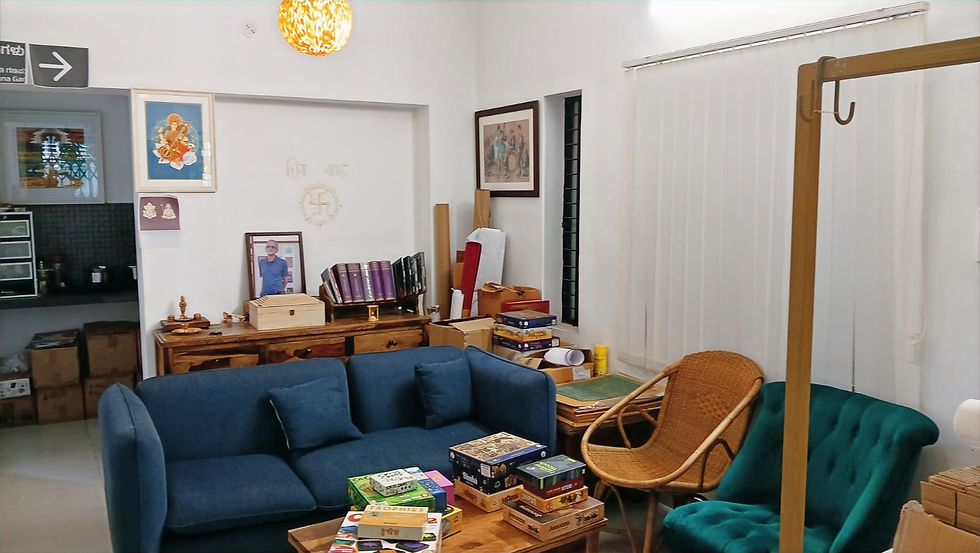
The studio itself functions as a shared learning space. Designers working on books encounter ideas emerging from exhibition projects. Researchers contribute to game design. Digital practitioners engage with environmental graphics. Knowledge moves across projects in unexpected ways. Some of the most significant learning happens indirectly—through observation, overheard discussions, unfinished prototypes pinned to walls, or informal conversations over coffee. The boundaries between teaching, learning, and practice become difficult to distinguish because all three occur simultaneously.
This culture has also shaped our relationship with time. Contemporary design practice often rewards speed and efficiency, but many of the projects we care about demand something slower. Cultural interpretation, public memory, education, and social impact cannot always be reduced to accelerated timelines. They require immersion, reflection, and patience. We have learned that meaningful design often emerges not from working faster but from staying with a question long enough for deeper insights to surface.
As a studio, we have also become increasingly aware that design is a form of performance. Every presentation, exhibition, publication, or digital experience is an act of storytelling. In projects such as the Freedom Fighters' Memorial or the environmental graphics for the Venkatappa Art Gallery, we are not simply arranging information. We are shaping how people encounter history, culture, and place. The designer's role becomes that of a mediator—someone who constructs experiences through which meaning can emerge.
Much of our work is rooted in Indian contexts, traditions, and knowledge systems. This has taught us that design is never culturally neutral. Every visual language, narrative structure, material choice, or interaction pattern carries assumptions about identity and values. Working with classical texts, educational content, public institutions, and heritage projects has continually reminded us that design participates in culture rather than merely representing it. The responsibility of the designer extends beyond communication into interpretation.
At the same time, we have found that the most rewarding projects often require a willingness to embrace uncertainty. Turning scientific history into a game, reimagining ancient texts for contemporary audiences, or creating experiences that bridge disciplines involves risks. Not every experiment succeeds. Yet experimentation remains essential because innovation rarely emerges from certainty. The studio must create conditions where ambiguity is not feared but welcomed.
Perhaps the most important thing we have learned is that studios do not simply produce artifacts. They produce people. Over time, designers acquire more than technical skills. They develop ways of seeing, questioning, collaborating, and making sense of the world. They learn how to navigate complexity, engage with different perspectives, and remain comfortable with incomplete knowledge. The books, games, exhibitions, and digital experiences that leave the studio are visible outcomes, but they are accompanied by another, less visible outcome: the ongoing formation of design identities.
Looking back, we realize that every project has been a vehicle for learning. Every critique has shaped our thinking. Every collaboration has expanded our understanding of design. The true work of the studio has never been limited to what we make. It has been about cultivating a culture where making, learning, questioning, and becoming are inseparable. In that sense, the studio is not simply where our work happens. It is the work itself.


Comments